

LIS–EHR Integration: Where Most Projects Break Down
LAB OPERATIONS & HEALTH IT
By U.S. HealthTek
Integration Isn’t the Problem. Misalignment Is.
Most LIS–EHR integration efforts don’t fail because of the interface. They fail because of misalignment across systems, workflows, and the process owners for both.
LIS–EHR integration is routinely treated as a technical milestone: build the interface, map the fields, validate the messages, move on. But most integration efforts don’t fail because of the interface. They fail because of misalignment across systems, workflows, and the people responsible for both.
The process looks deceptively simple. Orders flow from the EHR to the LIS, results flow back, the loop closes. In practice, laboratories operate in complex, dynamic environments where a purely technical framing leaves critical operational realities unaddressed.
Organizations with deep experience in laboratory operations, such as US HealthTek, have seen this pattern repeatedly: technically sound integrations that struggle in production because operational context was never fully accounted for.
WHERE INTEGRATIONS BREAK DOWN
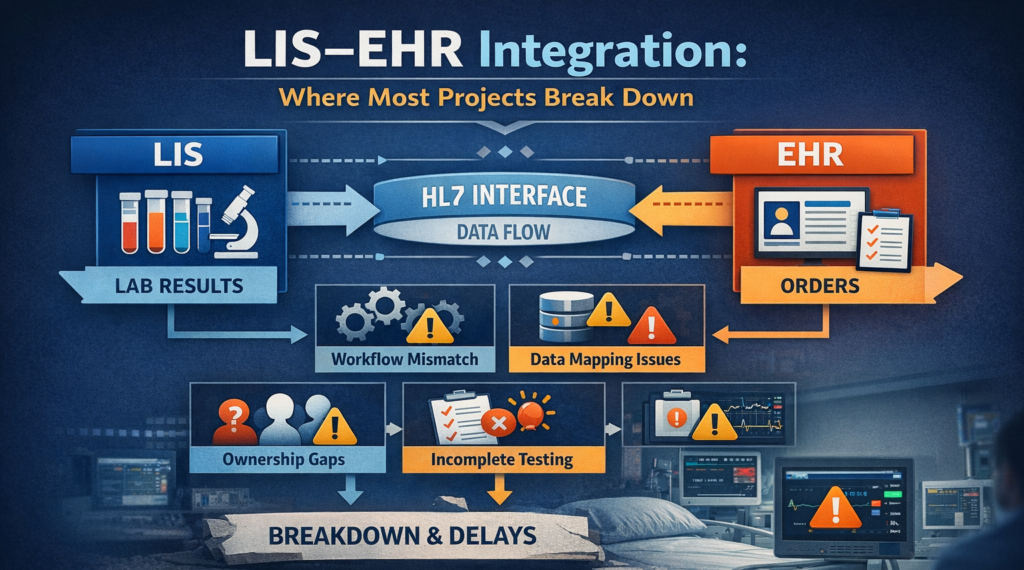
WORKFLOW MISMATCH
EHR workflows are linear by design. Laboratory operations are not. Labs batch, reflex, rerun, and intervene manually. When integration ignores these realities, it creates friction rather than efficiency. Friction compounds into delays, errors, and workarounds.
FRAGMENTED OWNERSHIP
Integration lives in the space between IT, lab operations, and vendors — and that space is often ungoverned. IT confirms messages are transmitted. Vendors verify system functionality. Lab teams absorb the consequences. Without clear accountability, problems fall through the gaps.
DATA MAPPING ASSUMPTIONS
Fields can align technically without aligning contextually. A test code, an abnormal flag, a reference range — each can carry different meanings across systems. These discrepancies rarely surface until go-live, when the cost of inaccuracy is highest.
SHALLOW TESTING
Most testing confirms that messages travel from point A to point B. It doesn’t confirm how the system performs under pressure. High volumes, exception handling, amended results, and downtime scenarios are routinely undertested — and routinely the source of production instability.
UNDERESTIMATING GO-LIVE
Go-live is treated as the finish line when it’s the starting line. When training is incomplete, monitoring is informal, and escalation paths are undefined, teams aren’t equipped to respond when things go wrong.
“Integration is not a one-time event. It’s a capability that must evolve alongside the lab.”
— Karen Saldaña, COO, U.S. HealthTek
WHAT HIGH-PERFORMING ORGANIZATIONS DO DIFFERENTLY
The organizations that get integration right treat it as an operational initiative, not a technical project. That distinction shapes everything.
- Establish cross-functional governance before the build begins
- Design workflows first, interfaces second
- Test against real-world scenarios, not just message transmission
- Plan for ongoing optimization, because integration is not an event, it’s a capability that has to evolve as the lab does
Labs are scaling, consolidating, and integrating into broader healthcare ecosystems. The stakes are higher and the margin for error is smaller.
A working interface is no longer the goal—it’s the baseline.
The organizations that succeed are those that move beyond interface delivery and focus on operational alignment: aligning workflows to reality, establishing clear ownership, validating data in context, and building processes that support continuous improvement after go-live.
This is where experienced partners play a critical role. Organizations like U.S. HealthTek support these efforts by bridging the gap between technology and operations—bringing together interface expertise, laboratory workflow design, data validation, governance frameworks, and post–go-live optimization.
Rather than approaching integration as a one-time build, the focus shifts to creating a sustainable capability—one that evolves with the lab, adapts to change, and continues to perform under real-world conditions.
Because in the end, integration isn’t about whether systems connect.
It’s about whether the organization does.