

How to Build a Healthcare IT Roadmap That Survives Budget Cuts
What You Will Learn in This Article
This article explains how clinical laboratories can build IT roadmaps that remain funded, defensible, and operationally safe during periods of budget pressure.
By the end of this article, you will learn how to:
- Protect patient results and turnaround time when IT budgets are cut
- Frame laboratory IT initiatives so executives understand the real risk of delay
- Phase IT projects to reduce disruption and survive mid-year reprioritization
- Identify optimization opportunities before committing to costly system replacements
- Build an IT roadmap laboratory leadership can defend under financial scrutiny
This guidance is designed for laboratory leaders, healthcare CIOs, and pathology organizations managing complex systems with limited tolerance for downtime or error.
How to Build a Laboratory IT Roadmap That Survives Budget Cuts
For clinical laboratories, information technology is not a back-office function—it is the backbone of daily operations. Every accession, result, interface, and report depends on systems working exactly as intended. Yet when budgets tighten, laboratory IT initiatives are often reviewed alongside enterprise projects that don’t carry the same level of clinical or operational risk.
The laboratories that continue to move forward in these conditions are not the ones with the most aggressive technology plans. They are the ones with IT roadmaps that leadership understands, trusts, and can defend. At U.S. HealthTek, we work exclusively with laboratories facing this challenge—how to modernize, streamline, and scale while protecting and preserving turnaround time, quality, and compliance through practical healthcare IT integration solutions designed for laboratory environments. The roadmaps that survive budget cuts share a common foundation: they are built around laboratory realities, not abstract IT goals.
Start With Test Integrity and Operational Risk
In a lab environment, IT risk is patient risk. Delayed results, failed interfaces, or manual workarounds can quickly cascade into compliance issues, staff burnout, and loss of clinician trust. A resilient laboratory IT roadmap begins by clearly tying initiatives to test integrity, result accuracy, and continuity of operations.
When leadership understands that a project reduces the risk of reporting errors, downtime, or accreditation findings, it becomes far more difficult to defer—regardless of budget pressure. Laboratory IT roadmaps fail most often when technology decisions are rushed or poorly scoped.
Read how labs reduce risk and plan change safely in our article, Software Development Services Doesn’t Have to Be Scary.
Define Laboratory Outcomes Before Technology
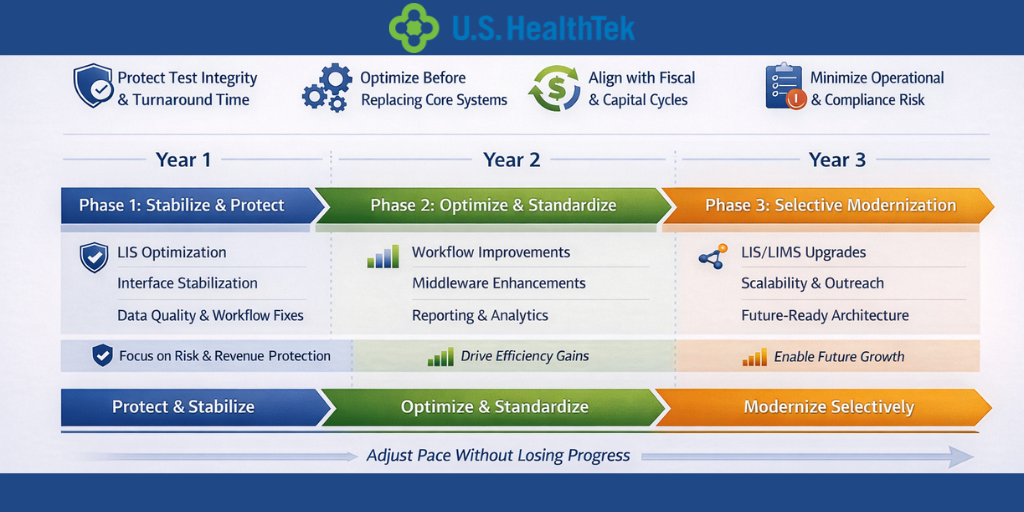
Laboratory IT roadmaps often struggle because they focus on systems instead of outcomes. Executives do not approve funding for LIS upgrades or middleware changes in isolation. They approve investments that improve turnaround time, reduce manual verification, stabilize interfaces, reduce technical debt, or strengthen audit readiness. In practice, these improvements are delivered through healthcare IT integration solutions that focus on stabilizing data flow and supporting day-to-day laboratory operations rather than introducing unnecessary complexity. A roadmap that translates IT work into measurable laboratory outcomes is easier to evaluate and far easier to defend during financial reviews.
Phase the Roadmap to Protect Daily Operations
Large, all-at-once laboratory IT initiatives are inherently risky, especially in hospital labs where downtime and parallel workflows can disrupt patient care. When budgets change mid-year, these initiatives are often paused entirely. Roadmaps that survive are intentionally phased. Each phase delivers independent value, reduces risk incrementally,
and minimizes disruption to testing. This approach allows leadership to adjust timing without sacrificing progress or operational stability.
Optimize Before Replacing Core Lab Systems
Most laboratories operate within complex ecosystems that include an LIS/LIMS, middleware, instrument interfaces, outreach workflows, billing and reporting tools that are built up over time. Replacing everything at once is costly, disruptive, and rarely necessary. A defensible roadmap identifies where optimization—rather than replacement—can deliver immediate gains. Improving workflows, stabilizing interfaces, or better configuring existing systems often produces meaningful value while controlling cost and risk. This pragmatic approach resonates strongly during budget scrutiny. In many laboratories, this work is enabled through targeted healthcare IT integration solutions that strengthen existing systems without adding operational disruption or unnecessary expense.
Download our Interface Solutions overview to see how labs reduce downtime, improve data flow, and extend the life of existing LIS and middleware investments.
Align IT Planning with Laboratory Finances
Laboratory budgets are shaped by payer mix, test volume variability, and reimbursement pressure. IT roadmaps that ignore these constraints lose credibility quickly. Strong laboratory IT roadmaps align initiatives with fiscal cycles, recognize the impact of revenue-cycle performance, avoid stacking high-cost projects in a single year, and focus on improving efficiency per test rather than simply expanding capacity. When IT planning reflects how the lab actually operates financially, leadership is far more likely to support it.
Use Governance to Protect Laboratory Priorities
In hospital environments, laboratory IT priorities can be overshadowed by broader enterprise initiatives unless governance structures clearly include lab leadership. Effective governance ensures that laboratory risk, compliance requirements, and operational realities are represented when reprioritization decisions are made.
Rather than slowing progress, good governance protects the initiatives that matter most when budgets tighten.
Make the Cost of Inaction Clear
When funding is constrained, leadership inevitably asks what can be delayed. In laboratories, the cost of inaction often appears months later as increasing manual work, longer turnaround times, interface instability, compliance exposure, or limited ability to scale outreach and specialty testing. Roadmaps that explicitly document these risks give leadership the context they need to make informed decisions—even under financial pressure.
Common Laboratory IT Roadmap Mistakes That Get Cut First
When laboratory IT roadmaps fail during budget cuts, it is rarely because the work was unimportant. It is because the risk was misunderstood.
The most common mistakes include:
- Treating laboratory IT like general enterprise IT
Laboratory systems directly impact patient care, regulatory compliance, and clinician trust. Roadmaps that fail to make this distinction are often deprioritized too easily. - Describing projects without defining consequences
When initiatives are framed as “upgrades” instead of safeguards against reporting errors, downtime, or compliance findings, leadership sees them as optional. - Bundling too much risk into a single phase
Large, all-at-once initiatives are harder to pause, harder to fund, and easier to cancel when budgets tighten unexpectedly. - Jumping to system replacement before fixing what already works
Skipping optimization weakens the business case and increases cost, disruption, and executive resistance.
Labs that avoid these mistakes dramatically improve the odds that critical IT work continues even under financial pressure.
A Roadmap Laboratory Leadership Can Defend
A laboratory IT roadmap is more than a planning document. It is a statement of what the organization cannot afford to lose. By grounding the roadmap in patient impact, operational outcomes, phased delivery, and financial reality, laboratories and hospital labs can continue to move forward—even when budgets are tight.
How U.S. HealthTek Can Help
U.S. HealthTek partners with clients to design and execute IT roadmaps that hold up when the stakes are high and the margin for error is low. We help organizations stabilize and optimize existing lab systems or implement new ones, plan defensible modernization efforts, and deliver complex initiatives without disrupting testing, compliance, or patient care. If your laboratory is facing difficult prioritization decisions or struggling to keep critical IT initiatives moving, U.S. HealthTek can help you build a roadmap leadership will stand behind—no matter the budget climate.
Frequently Asked Questions
- How long should a laboratory IT roadmap be?
Most laboratory IT roadmaps should span 18 to 36 months, with detailed near-term plans and flexible longer-term phases that allow adjustment during budget or priority shifts. - Why do laboratory IT projects get cut before enterprise projects?
Laboratory risk is often misunderstood by non-lab executives. Without clear documentation of patient impact, compliance exposure, or operational consequences, lab initiatives may appear less urgent than they truly are. - Is optimization really enough without replacing core systems?
In many cases, yes. Stabilizing interfaces, reducing manual workarounds, and improving configuration often delivers significant gains without the risk and cost of full replacement. - How can labs justify IT spending during budget cuts?
By tying initiatives to measurable outcomes like reduced downtime, fewer reporting errors, improved turnaround time, and decreased compliance exposure rather than technology alone. - Who should approve and govern laboratory IT roadmaps?
Effective governance includes laboratory leadership, IT leadership, and compliance stakeholders to ensure lab priorities are represented during enterprise decision-making.